OEE, TEEP, & OOE: What are the differences & how to calculate them
OEE, TEEP, & OOE: What are the differences & how to calculate them
The acronyms TEEP, OEE, OOE represent three related metrics that calculate the effectiveness of manufacturing equipment.
More precisely, these KPIs are used in production plants to measure different aspects of availability (i.e., machine running time) in relation to performance and quality.
Let’s look at what these metrics are and the differences between them.
What is OEE?
ΟΕΕ (Overall Equipment Effectiveness) evaluates the percentage of planned production time that is truly productive.
In essence, it calculates the effectiveness and performance of manufacturing processes or specific equipment during scheduled operating hours only, excluding maintenance and cleaning time, lunch breaks or other pre-arranged downtime.
Today, OEE is a major ROI standard where loss analysis allows manufacturers identify root causes that ultimately improve production and drive investment decisions.
What is OOE?
OOE (Overall Operations Effectiveness) demonstrates equipment effectiveness during the total operating time of the manufacturing plant. It takes into consideration the entire shift time, including hours when machines are not running, like during staff meetings or inspection.
In other words, OOE calculates performance and output quality in relation to shift time. It is a powerful metric that can assess production line effectiveness, maintenance operations efficiency, or quality control measures.
What does TEEP mean?
TEEP means (Total Effective Equipment Performance). This metric calculates a factory’s production quality and performance against all available time – 24/7 x 365.
It presents production planners with an ideal scenario of the true production capacity without any time restraint, like shift time, equipment maintenance, supply chain shortages, or anything else.
OOE vs. OEE vs. TEEP
All three machine utilization formulas help manufacturers measure, analyze, and, as a result, improve operational efficiency.
They all calculate production quality in relation to equipment performance and different measurements of the Maximum Time available for a machine to run.
In these KPIs, a 100% score signifies a manufacturing plant with high efficiency and high productivity. A low score, on the other hand, indicates a hidden factory with unused resources, waste production, and loss instead of value.
So, the only changing variable between OOE, OEE, and TEEP is the way they define the variable of availability.
The basic formula, though, is identical:
OOE, OEE, and TEEP calculation
Performance x Quality x Availability
Let’s look at how the concept of Availability or Maximum Time is used in every calculation.
The 3 aspects of availability for OOE, TEEP, OEE calculations
All available time
TEEP (Total Effective Equipment Performance) considers maximum time as all available time, 24 hours a day, 365 days a year. Depending on what you want to assess, you can break up maximum time into smaller chunks, like a week (168 hours), for instance.
TEEP calculation
TEEP = Performance x Quality x Availability (where Availability = Actual Production Time / All Time).
The aspect of ‘all time’ offers an insight into a factory’s max available capacity and the most efficient use of assets.
Total operational time
OOE (Overall Operations Effectiveness) applies to an inner layer of maximum time which is the total operating time. It includes planned downtime, i.e., those hours where machinery doesn’t actually operate, like scheduled maintenance, lunch breaks, etc.
However, it doesn’t take into consideration unexpected stops such as machine breakdowns or supply shortages.
OOE calculation
OOE = Performance x Quality x Availability (where Availability = Actual Production Time / Operating Time)
OEE guides decision-making when businesses want to expand manufacturing capacity, boost productivity, or scale overall operations.
For instance, if demand isn’t met, there may be an issue with equipment performance or production line effectiveness. But if machinery is functioning as expected but demand still isn’t met, there may be a capacity problem.
Planned production time
OEE (Overall Equipment Effectiveness) calculates the core layer of maximum time measurements that considers ‘pure’ operational performance or scheduled time. It excludes planned downtime but not unexpected stops like unplanned maintenance or lack of operators.
To get a better understanding, let’s get into more detail on planned and unplanned downtime.
Planned downtime
Planned downtime (or scheduled downtime) includes planned stops like: shift handovers, planned maintenance, cleaning, tooling adjustments, meetings, quality inspections, toolbox talks, paid breaks, etc.
Unplanned downtime
Unplanned downtime (or unscheduled downtime) refers to unexpected stops that typically occur on the shop floor, like: equipment failure, machine misuse, lack of operators, system issues, blockages, shortages, etc.
These unplanned stops are calculated in OEE to determine the total effective equipment performance.
OEE calculation
OEE = Performance x Quality x Availability (where Availability = Actual Production Time / Scheduled Time)
Calculating scheduled time measures operational performance against equipment availability. OEE is a valuable metric that sheds light on machine or system improvements that ultimately boost productivity.
On top of Availability, OEE, OOE, TEEP calculations depend on performance and quality.
Unlock the full potential of your production line!
Performance in equipment utilization
Performance here refers to the actual performance against the Maximum Demonstrated Rate (MDR), or ideal cycle time, of the plant or machine.
In real life, various micro stops or slow cycles during manufacturing operations cause diverse performance losses.
What are Micro Stops?
Micro-stops occur when equipment stops operating for a few moments (typically less than a minute). They mostly have to do with small, non-value added tasks such as material jams, part swapping, sensor misalignment, quick clean-ups, etc.
Sometimes, these stops are so short or common that they are not always considered by operators. That’s why the best way to collect accurate data is via smart monitoring systems that identify and record such tiny time-wasters as micro stops.
What are Slow Cycles?
This term describes a situation where a machine operates slower than its maximum speed. It may result from poor cleaning, worn-out parts, or on purpose.
Quality in Machine Utilization Formula
Another area of efficiency loss in manufacturing is production quality. Quality here means that production meets the right specifications right from the start.
Quality is affected by 2 issues:
Production rejects
Defective parts produced during stable (or steady-state) production, e.g. lot expiration in pharmaceuticals.Startup rejects
Defective parts produced until stable production is reached, due to e.g. equipment calibration issues or packaging misalignment.
Summing up, optimal pharma manufacturing operations deal with all kinds of measurements and details. It’s quite difficult (if not impossible) to capture them all. That’s where real-time, automated OEE software comes in.
AI-Driven OEE Analytics
Extracting and calculating your OEE manually is an error-prone process that most likely won’t get you precise results and measurements. Companies with fully automated OEE data capture, report much stronger OEE results.
Artificial Intelligence
Artificial intelligence algorithms have been employed to go through a vast volume of accumulated data, action plans, and their impact on the process in order to “train” the system through machine learning to be able to propose immediate solutions and actions to real industry problems thereby enhancing and speeding up troubleshooting routines and evaluating different potential improvement scenarios.
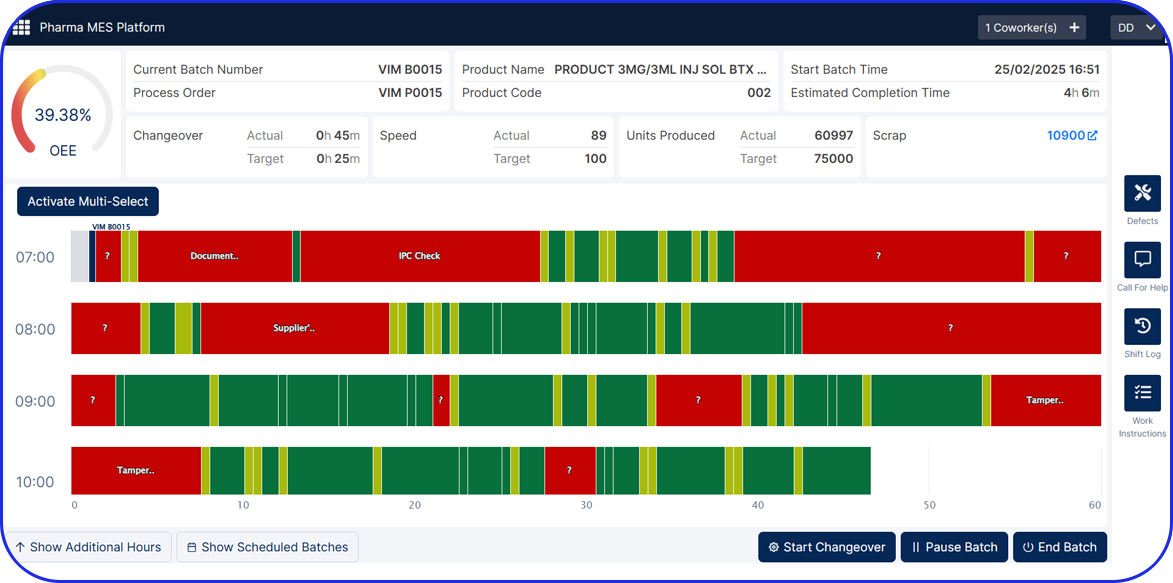
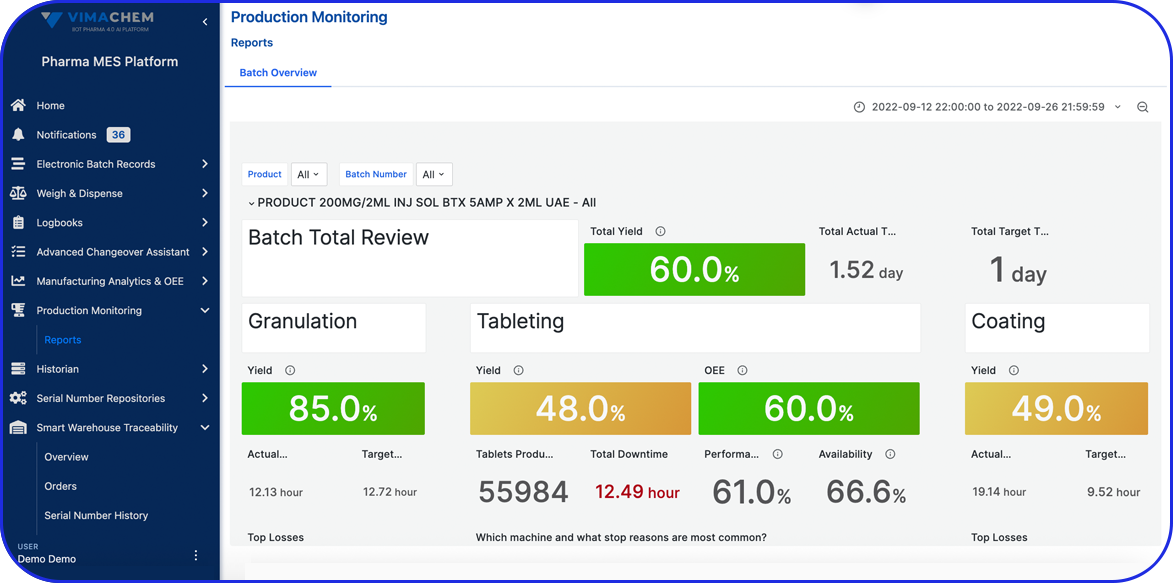
For Life Science industries, Vimachem’s AI-Driven Manufacturing Analytics & OEE solution assists Pharma manufacturers in monitoring machine utilization and OEE, to achieve operational excellence and scale to reach their utmost potential.
Vimachem OEE is a cutting-edge Pharma OEE Cloud solution that allows you to collect, store, monitor and visualize data across your sites for optimal production operations and enhanced product quality. Experience the new era of OEE analytics with Vimachem. Get your demo today.
// Want to learn more?
Contact us
Ready To Augment Your Shop Floor Operations?
Ready To Augment Your Shop Floor Operations?
Vimachem Manufacturing Analytics - OEE
The Manufacturing Analytics – OEE module is an intelligent Pharma OEE Cloud solution that allows you to collect, store and visualize data across your site / enterprise and apply AI algorithms to optimize production efficiency and product quality.