In GMP manufacturing, the question isn't whether a batch will change during execution; it's how your EBR handles it when it does. A pH reading on an API reactor drifts toward the edge of range and needs an extra charge to correct it. A stopper feeder jams on a filling line and someone has to step in by hand. A temperature sensor fails on a blister line and must be replaced during batch execution. None of this is rare. It's a daily reality across pharmaceutical manufacturing.
In paper-based GMP manufacturing, these unexpected events don't automatically stop production. Operators and supervisors can document approved deviations, supplemental instructions, or create process adjustments directly within the batch record, maintaining compliance, traceability, and operational continuity.
Move that same batch record into many legacy MES or eBR platforms, and the same fix stops being a five-minute conversation. Adding a step, adjusting a workflow, or capturing an unplanned instruction can mean redesigning part of the electronic batch record, regression testing it and running it back through validation—a cycle that can take weeks in the best case and months in the worst. Alternatively, the site may have to revert to paper as a last resort under its business continuity procedures. The system built to eliminate paper ends up less flexible than the paper it replaced.
Instead of improving execution, many legacy EBR platforms force manufacturers to choose between operational continuity, production speed, and compliance, three things they should never have to trade off.
The Hidden Cost of Starting a New Batch
Ask anyone who has lived through this and they will tell you what really happens when a legacy EBR cannot absorb an in-process change. The batch gets ended. Not paused, ended, logged as aborted or cancelled. The workflow gets redesigned offline. It goes through configuration, regression testing, and re-approval. Only once that is done does a new batch get started, often days later.
In between, the line sits idle. So does the team. Material that was already staged or partially processed may need to be quarantined, reworked, or scrapped, and documented as its own deviation. None of this shows up on a product roadmap slide, but it is one of the more common reasons digitization projects lose credibility on the shop floor. Operators do not experience "we digitized the batch record." They experience "the previous process used to let me fix this in five minutes, and now it takes three days and a phone call to IT."
Where Unexpected Changes Become Operational Challenges - Have You Encountered These Scenarios?
Most people running a shift have lived through some version of the following. Let's see if any of these sound familiar.
The API reactor, mid-synthesis.
An in-process pH reading trends toward the edge of the acceptable range. The shift supervisor authorizes a small additional reagent charge or an extended hold to bring it back, a step that does not exist in the original recipe. Recording that as an ad hoc note outside the system creates a traceability gap. Recording it as a signed batch amendment, tied to the exact process step and time, keeps the full genealogy of the batch intact.
The blister line, mid-batch.
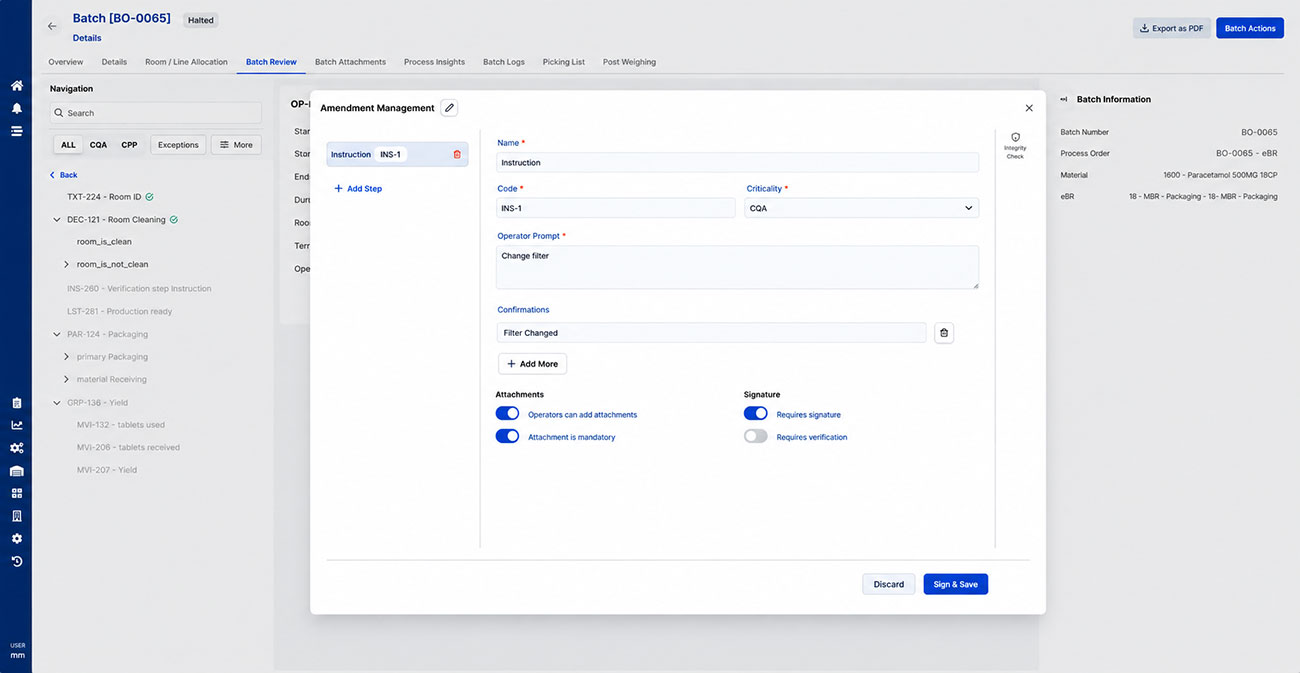
A temperature sensor fails during batch execution, and maintenance replaces it under an approved intervention procedure. In a rigid EBR, adding the required follow-up actions can mean editing the batch design or documenting the instruction outside the batch record, creating additional documentation and review effort. With in-batch editing, the supervisor opens the running batch on the HMI and adds a controlled instruction for the operator to clean the affected machine area using the specified cleaning material. The supervisor also adds an IPC check to verify and record the temperature following the replacement and captures the replacement sensor’s identification number directly in the batch record. The intervention is documented where it occurred, linked to the running batch and signed by the responsible user. The line can continue under controlled conditions, with QA reviewing the amendment as part of batch release.
The filling suite, an hour into the run.
A stopper feeder jams during aseptic filling. Clearing it means a manual intervention that was never in the master batch record, plus an extra in-process check to confirm nothing was compromised. In-batch editing lets the supervisor insert that instruction and the additional check directly into the running batch, capturing who did it, when, and why, without pausing the batch to redesign the workflow around a one-time event.
Three different production environments, upstream, filling, and packaging, and the same underlying need: a documented, signed way to change course mid-batch without leaving the system or stopping the line.
How In-Batch Editing Works in Practice
What ties those three moments together is a single capability sitting inside the EBR: the ability to amend a running batch without leaving the system or breaking its record. This is what batch amendments are built for.
A supervisor can insert an instruction, a check, or a corrected value at the exact point in the batch where it is needed, name the amendment, and route it through configurable approval signatures. The batch itself will not resume, or release, until every amendment tied to it has been signed off. Every change carries the original value, the new value, who made it, and why, in a permanent audit trail. Nothing is hidden, and nothing requires taking the line down to fix.
On the review side, this pairs with review by exception. QA does not re-check every step of a batch that ran clean. Reviewers focus on the exceptions and amendments that were actually flagged during execution, sign off on those, and release the batch. Deviation handling moves from a paperwork queue that trails the shop floor by days to a review that keeps pace with it.
Why Real-Time Production Can't Wait for Change Control
The thread running through the blister line, the filling suite, and the API reactor is urgency. A shop floor exception does not arrive on a schedule that matches a software change control cycle, and it should not have to. The plants that get the most value from digitization are the ones where a supervisor can resolve an in-process problem in the same shift it happens in, with a full signature and audit trail behind it, rather than choosing between reverting to paper or shutting the batch down.
Digitizing the batch record was supposed to make manufacturing more agile, not less. In-batch editing is the difference between those two outcomes.
See how in-batch editing keeps production moving.
Purpose-Built for Real-World Manufacturing
We built batch amendments and review by exception into the EBR module as standard, configurable capabilities, not custom development or a professional services add-on. Any customer running Vimachem's EBR has this today.
In practice, that means a supervisor can insert instructions, corrected values, or additional checks into a batch that is already running and route them through the configured e-signature approval flow. Every change is automatically captured in the audit trail QA reviews at release. There is no separate configuration project or regression testing cycle.
This is why operational flexibility has become one of the defining characteristics of modern EBR platforms. Manufacturers don't just need systems that can digitize a batch. They need systems that can scale across products, processes, and sites without slowing operations every time reality differs from the master record.
If shop floor exceptions are turning into multi-day detours in your current system, we are happy to walk through how this works against your own process.