
Kenya is moving from batch-level traceability to full unit-level serialization on 1 January 2027. The Pharmacy and Poisons Board (PPB), working with the Digital Health Agency (DHA), is introducing a national Authentication and Traceability (A&T) system that covers locally manufactured and imported health products and technologies (HPTs). The message for anyone supplying Kenya, whether a local manufacturer, importer, MAH, local technical representative, CMO, 3PL or distributor, is simple: use the transition period to get ready before full requirements apply.
Kenya’s regulation follows GS1 standards, so companies with existing serialization infrastructure are not starting from zero. The technical detail is still being finalized, however, and part of preparing well is knowing which rules are fixed and which are still open.
Regulatory Timeline at a Glance
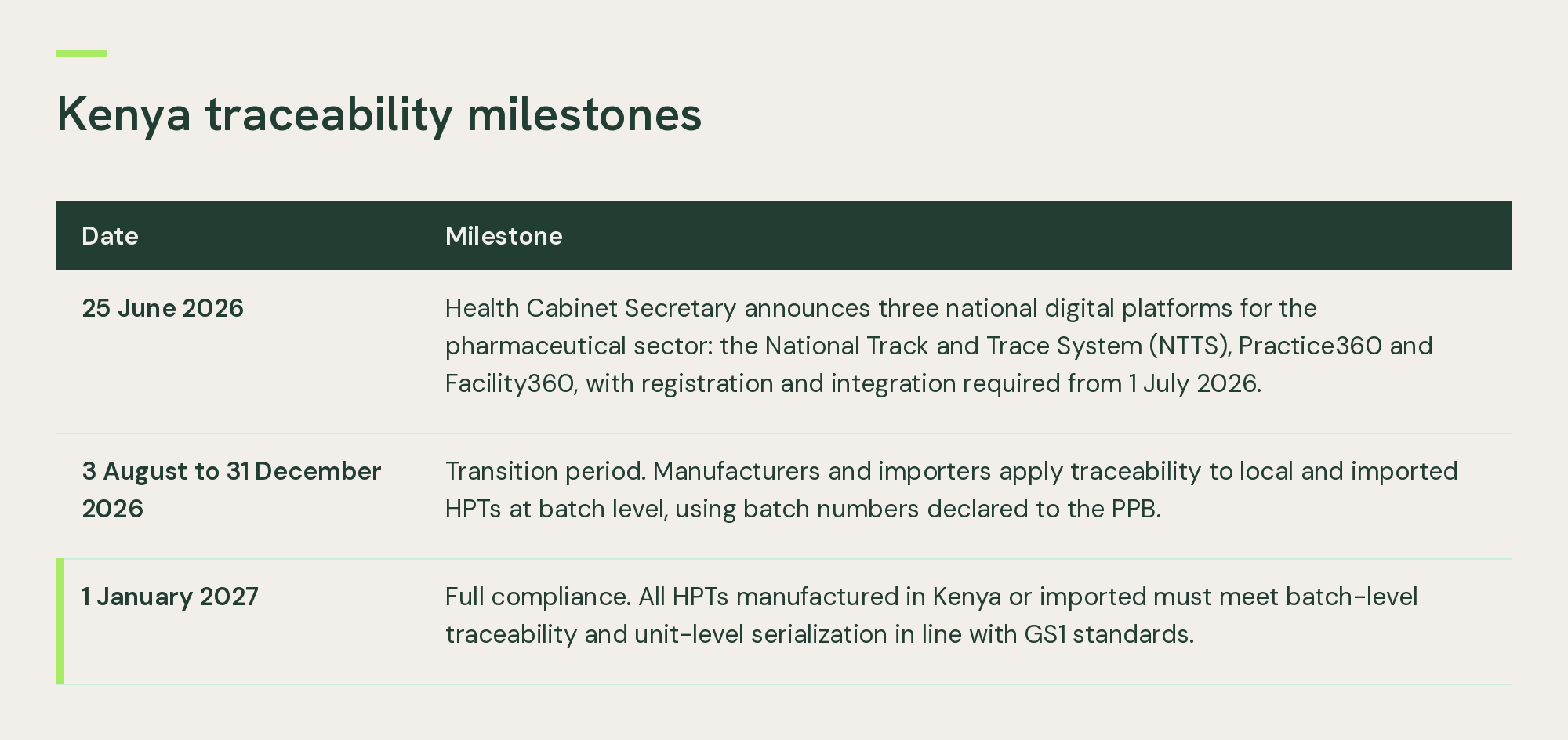
The national system is being introduced under Kenya’s Digital Health Act, 2023, which provides for a health information system supporting the authentication, tracking and tracing of HPTs. According to the PPB’s announcement, the rollout runs in two steps:
In preparation for the pilot and launch, the DHA requires marketing authorization holders, manufacturers, importers and local technical representatives to submit the required data and to complete system integration before 1 January 2027. Wholesalers, distributors, retail pharmacies and other downstream actors will be onboarded by the PPB and DHA according to separate implementation timelines.
What This Means for Kenya
Kenya’s approach combines a centralized national repository, GS1-based serialization on every saleable pack, SSCC identification of logistic units, and verification at each change of ownership through to dispensing. The PPB’s Standards for Authentication and Traceability of Health Products and Technologies set out the technical framework. The points below are based on that document, the PPB and DHA announcements, the Ministry of Health directive, and industry commentary.
The Ministry of Health Directive
The national system was first announced by the Ministry of Health at the Pharmaceutical Society of Kenya conference on 25 June 2026. According to press coverage of that announcement, manufacturers, importers, distributors, wholesalers, pharmacies and healthcare facilities must register and integrate with the National Track and Trace System, comply with GS1 global standards for product identification, serialization, authentication and traceability, and capture and report pharmaceutical products and transactions through the National Logistics Management Information System (LMIS) and the NTTS. They must also keep accurate electronic records of inventory, distribution, dispensing and utilization, and ensure interoperability with the standards prescribed by the DHA.
The Ministry cited 1 July 2026 as the start for platform registration, while the PPB later set 3 August 2026 as the go-live date of the A&T system.
Scope: Which Products and Which Parties
The standard is broader than prescription medicines. It covers oral, non-oral and topical medicines, suppositories, herbal products, medical devices and in-vitro diagnostics, and cosmetic products with medical claims. It applies to manufacturers, importers, distributors, wholesalers, pharmacies, healthcare providers, dispensing personnel, logistics providers and A&T service providers, from batch release to the point of administration or dispensing.
The July 2026 announcement applies full requirements to all HPTs from 1 January 2027, so companies should plan for their whole Kenyan portfolio rather than a subset.
Product Identification and Data Content
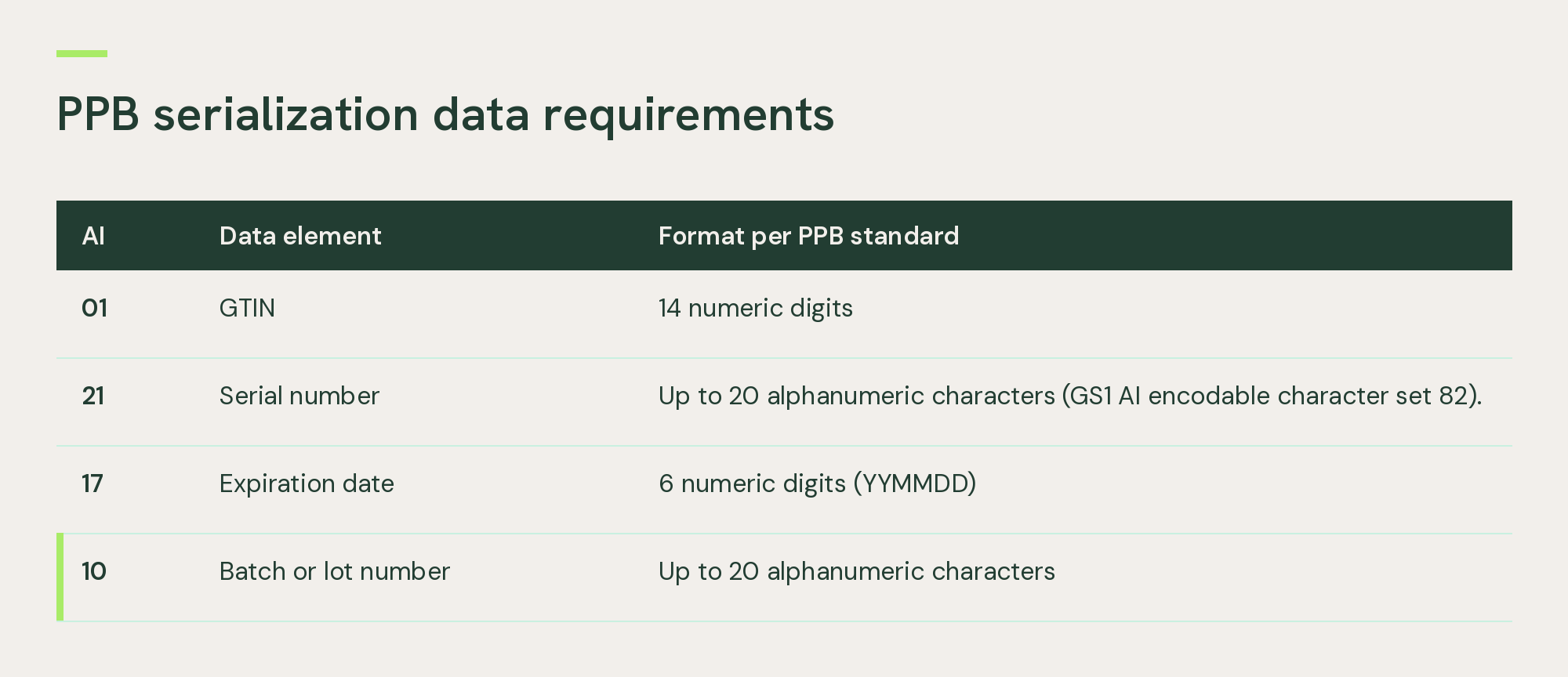
Every serialized unit carries a unique identifier made of a GTIN and a serial number, encoded with GS1 Application Identifiers. The PPB specifies GTIN-14 for HPTs, with the check digit verified in application software. The data content is:
PBB serialization data requirements
The standard’s worked example encodes the data in a GS1 DataMatrix with a symbology identifier, AI 01 and AI 21 first, followed by a group separator (FNC1), then AI 17 and AI 10.
Where there is no secondary pack, the primary pack carries the identifier. Companies with products sold in multiple presentations, hospital packs or loose blisters should review each pack configuration against these rules early, because they can drive artwork and line changes.
Aggregation and Logistic Units
The standard treats aggregation as part of the Kenyan model:
• Tertiary units, such as cases and pallets, receive a Serial Shipping Container Code (SSCC). The hierarchy can be as deep as the business needs, from serialized secondary packs into serialized cases and onto pallets.
• Logistic unit labels can use a GS1-128 linear barcode or a GS1 DataMatrix encoding the SSCC, with the relevant GTIN, expiry date and batch data also carried.
• For nested or aggregated units, only the barcode of the highest logistic unit should be legible. Lower-level logistic unit barcodes must be hidden. If EPC/RFID tags are used, the filter value of the higher unit must differ from that of the lower units.
• On import, the SSCC of tertiary units is considered for inspection and verification before the PPB releases the products.
Companies should plan for aggregation and confirm the exact enforcement scope with the PPB and DHA.
Verification and Reporting
Kenya has chosen a centralized model with a full A&T approach, in which all traceability data sit in a single secure repository managed by the PPB, directly or through A&T service providers. Products are verified individually at serial level, and every change of ownership requires traceability documentation or verification. In practice this means:
• Verification and authentication at every location in the supply chain: manufacturer, importer and distributor or wholesaler.
• Scanning of the 2D code by the healthcare professional at the point of dispensing, with the identifier sent to the central database over a secure connection.
• A real-time response of Valid, Invalid or Verification Pending. An invalid result means the product should not be dispensed and the incident is reported to PPB post-marketing surveillance.
• Checks on serial number validity, product data, dispensing eligibility and supply chain integrity, including whether SSCC verification took place at distribution level.
• Patient verification through a mobile app linked to the central database.
Stored data include the unique identifiers (GTIN, serial number, SSCC), product information (name, batch, expiry) and transaction data (manufacturing, distribution, dispensing).
The PPB standard refers to GS1 EPCIS and to decommissioning events in its glossary. Companies should confirm the applicable reporting events, message formats and integration requirements against the latest PPB and DHA guidance before implementation.
Who Should Act Now?
As with every modern serialization rollout, the scope extends well beyond manufacturers:
• MAHs and local technical representatives, who carry the data submission obligation to the DHA.
• Local manufacturers and packaging partners, including contract packagers.
• Importers, and CMOs and manufacturers abroad packaging for Kenya.
• Distributors, wholesalers and 3PL warehouses, which will be onboarded after upstream actors.
• Pharmacies, hospitals and clinics as the dispensing endpoint of the chain.
The practical reality is simple: if any link cannot handle serialized stock correctly, data integrity breaks down and operational risk rises.
Why Early Preparation Matters
Kenya’s model creates challenges that make early planning essential. First, the transition window is short. Companies need product master data, GTIN-14 mapping, batch declarations and DHA onboarding in place while packaging changes are still being validated. Second, artwork and line changes for Kenya-specific packs take time, particularly where multiple presentations need individual identifiers. Third, the final DHA specifications are still to come, so systems must be flexible enough to adapt without rework. Fourth, importers need SSCC-labelled shipments that can pass PPB inspection and verification, so the logistics chain must preserve parent-child relationships.
What Does Good Preparation Look Like?
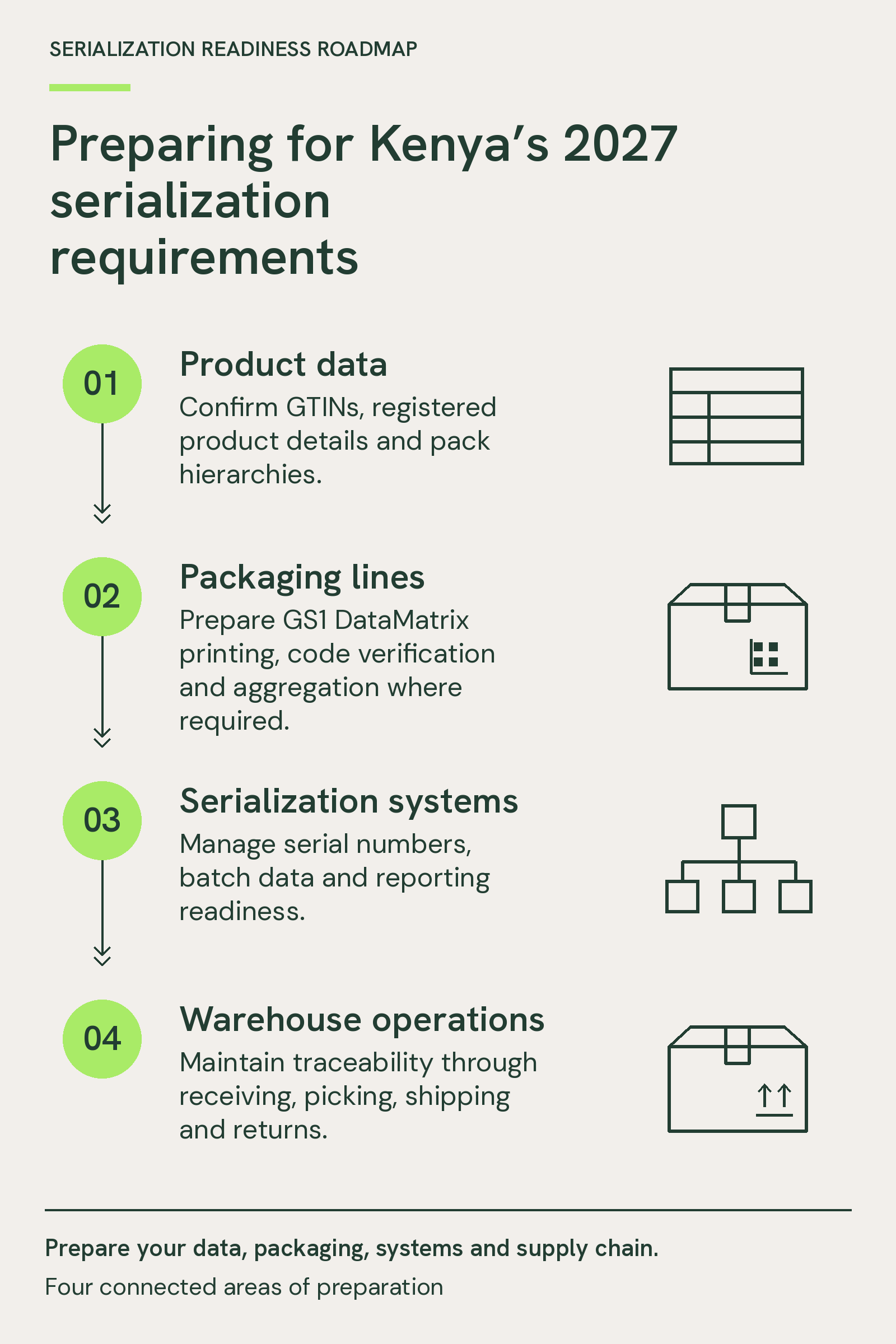
Based on global serialization rollouts, good preparation for Kenya involves readiness across four connected areas:
• Product Master Data and GS1 Setup. Serialization projects are usually delayed by data quality more than by barcode technology. Build one master file with the PPB registration number and exact registered product name, pack sizes and the full pack hierarchy, manufacturing site as registered, and batch number format. Confirm that you hold a GS1 company prefix, from GS1 Kenya or from the GS1 member organization where the brand owner is registered, and map your GTINs to the GTIN-14 format. Local industry advisers flag the prefix as a critical path item, because obtaining one takes time.
• Packaging Line Readiness. Production lines must be technically capable of printing and verifying a GS1 DataMatrix on the correct pack level, rejecting bad codes, and aggregating where it applies. Review artwork, code placement, print quality grading and change control for Kenya-specific packs. Without stable, well-trained line operations, even the best IT systems will struggle.
• Serialization Management Readiness. Companies need central control over serial numbers, batch and product data, and a clear path to exchange data with the DHA once its specifications and templates are released. Reusing an existing global serialization architecture with Kenya-specific configuration is usually faster and cheaper than building an isolated country solution.
• Warehouse and Distribution Readiness. Serialization does not end when products leave the line. Warehouses and distributors must receive, store, pick and ship serialized and SSCC-labelled stock without breaking data integrity. This is where smart warehousing capabilities become critical.
Why You Should Choose Vimachem as Your Compliance Partner
At Vimachem, our key differentiator is not just compliance but flexibility, scalability, and operational excellence.
A Central Hub Ready for the Kenyan Reporting Environment
Kenya’s regulation depends on clean, consistent product, batch and serialization data reaching the national system. Vimachem’s Level 3/4 Serialization Site Manager manages product master data, serial number lifecycle, aggregation hierarchies and event data at site level, and acts as the interface between packaging lines and external reporting systems. As the PPB and DHA issue their data specifications and integration guidelines, Vimachem’s approach is to align the configuration of the Site Manager to them, so companies do not need to rebuild their serialization setup for each new market.
Off-the-Shelf, Ready-to-Deploy, and Agnostic
The Vimachem Serialization Site Manager Level 3/4 solution is L2 and L4-agnostic, giving our customers the flexibility to select the most appropriate Level 2 solution for each packaging line, from high-speed automated lines to low-speed or semi-automatic lines or even fully manual serialization and aggregation scenarios. This avoids overengineering and significantly reduces long-term cost and vendor lock-in. With 50+ customers globally using various L2s across the site, we have proven that flexibility and avoidance of vendor lock-in are the most secure and cost-efficient way to start and scale pharmaceutical serialization.
Built for Zero Downtime Operations
Serialization should never compromise supply continuity. Vimachem’s solutions are designed to go live with no production downtime, supporting parallel rollout, phased go-lives and controlled validation strategies. This lets companies stay fully operational while they upgrade their serialization and reporting capabilities.
The Vimachem Serialization Modules
We provide pharmaceutical companies with modular, regulation-ready serialization solutions across packaging, warehousing and distribution. Our portfolio is designed to scale with evolving global requirements, including emerging markets such as Kenya.
Vimachem Level 3/4 Serialization Site Manager (SSM)
Vimachem’s Site Manager (SSM) is a Level 3 and 4 serialization and aggregation solution that serves as the central hub between packaging lines (Level 2) and reporting systems. For Kenya, it helps companies to:
• Manage GTIN, batch, expiry and serial number data in line with the PPB data content, including GS1 DataMatrix content and the unique serial number rule.
• Handle commissioning and aggregation to SSCC at site level, keeping serialization and aggregation consistent from line to warehouse.
• Prepare the product, batch and event data that the DHA specifications will require, and keep audit trails for inspection.
• Support multi-market operations, so the same site setup can serve Kenya alongside other regulated markets.
Vimachem Smart Warehouse Traceability (SWT)
Vimachem’s Smart Warehouse Traceability (SWT) is a dedicated warehouse traceability module for pharmaceutical, biotech and logistics operations that need serialized and aggregated product tracking, including scan-driven receiving and shipping. Because Kenya verifies at every change of ownership and uses SSCC at distribution level, SWT helps importers, distributors and 3PLs to keep the SSCC-to-child-pack relationship intact through receiving, put-away, picking, shipping and returns.
Vimachem Manual Serialization and Aggregation Module (MSAM)
Vimachem’s Manual Serialization and Aggregation module is a lightweight, operator-driven tool that allows operators to enter or scan serial numbers manually. It fits low-volume presentations, repackaging and Kenya-specific pack configurations where full line-level serialization or aggregation is not available, so traceability stays consistent in manual segments.
Looking Ahead to 2027
Kenya’s timeline is close: batch-level declarations are already due during the transition period, and unit-level serialization applies from 1 January 2027. Companies that act early can avoid a rushed implementation, validate artwork and line changes in time, and adapt to the final DHA specifications without disruption. With Vimachem’s serialization solutions, pharmaceutical companies can meet Kenya’s requirements efficiently and turn a regulatory obligation into a more transparent and resilient supply chain.
Discover how the Vimachem Pharma MES Platform helps you avoid compliance gaps as Kenya’s serialization requirements come into force.