Serialization is a constantly changing operation with new requirements (e.g., aggregation), evolving regulations (USA, UAE, etc.), and partner business updates, resulting in a constant increase in complexity, risk, and of course, costs.
Multiple companies in the industry are currently offering serialization solutions. But these systems are often complex, inflexible, and unable to efficiently meet the constantly evolving global serialization requirements.
Common Challenges Pharma Companies Face with Serialization
1. Regulatory Updates Demand Costly and Slow Software Upgrades
Pharmaceutical regulations are constantly evolving, with new requirements like aggregation, traceability, and digital reporting. Vendor-locked serialization systems make these updates slow, complex, and expensive, forcing companies into costly upgrades dictated by a single provider.
2. Scalability Becomes a Major Hurdle in Global Expansion
Expanding into new markets means complying with different serialization laws (e.g., DSCSA in the U.S., EU FMD in Europe, Tatmeen in the UAE). Rigid systems lack flexibility, making it difficult for pharma companies to scale operations without extensive system overhauls.
3. Supply Chain Integration Issues Limit Collaboration
Pharmaceutical manufacturing involves multiple stakeholders, including CMOs, CDMOs, wholesalers, and distributors. Vendor-locked serialization solutions restrict interoperability, making it challenging to exchange data across different systems. Without seamless communication, supply chain inefficiencies increase, leading to delays, compliance risks, and higher costs.
Avoid Dependency on a Vendor-Locked Serialization Solution
Many providers supply not only serialization equipment but also software and integration with a company's IT infrastructure. However, once such software is installed, it can only be used with that vendor's hardware. In this circumstance, the pharmaceutical company cannot do business with any other vendor because the software and, in many cases, the hardware are incompatible. This constraint rapidly decreases operation efficiency and negotiation power. Furthermore, it results in ever-increasing costs due to both the by-design inflexibility of the all-in-one vendor systems as well as the ongoing upgrade costs.
The Open-SCS Standard: Breaking Free from Vendor Lock-In
The Open Serialization Communication Standard (Open-SCS) working group is a partnership of pharmaceutical manufacturers and vendors responding to this call to action. Its purpose is to create an industrial interoperability standard for healthcare package serialization requirements that will increase deployment efficiency while lowering compliance costs. Open-SCS enables a pharmaceutical company to use a "best-of-breed" strategy for various product presentations (carton, bottle, pouch, etc.) and select the most appropriate vendor for the job.
Open-SCS is designed to standardize communications across the layers of functionality required to provide a serialization solution based on the ISA-95 paradigm for an automation interface between a company's control systems. The ISA-95 model specifies a set of "functional layers" that must be present in any correctly developed manufacturing system. Flexibility, durability, dependability, and speedier implementation are all advantages of a layered approach to solution architecture for both the solution developer and the end-user.
How to Future-Proof Your Serialization Strategy
Audit Your Current Serialization System
Are you locked into one vendor?
Assess Compatibility
Does your software integrate with multiple hardware vendors?
Look for Open-SCS Compliance
Ensure your solution supports standardized communication.
Consider the Vimachem Level 3 Serialization Site Manager (SSM)
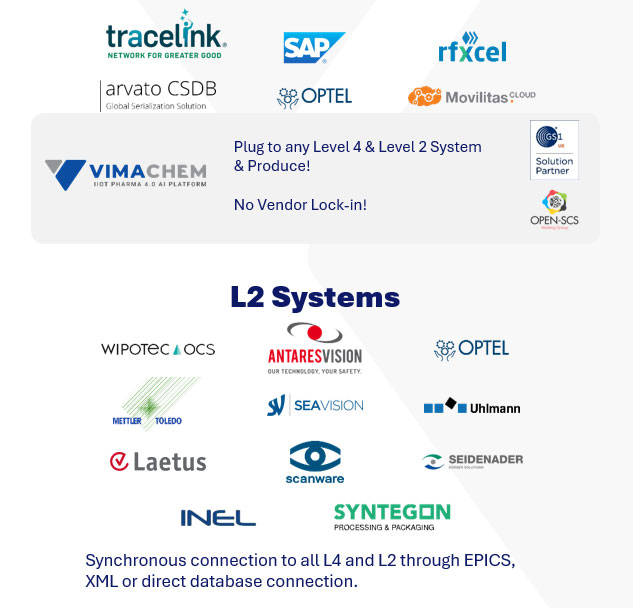
The Vimachem Level 3 Serialization Site Manager (SSM) is the world's largest line and network agnostic serialization software solution with Open and standardized interfaces that ensure unrestricted use with respect to all machines and components already in use at a manufacturer's site. In addition, its flexible interface technology enables it to connect readily (plug & produce/create) with any line or network system. This feature provides a best-of-breed serialization solution while avoiding the drawbacks of single-vendor systems (vendor lock-in, sluggish response times).
Key Benefits of Vimachem SSM
- Reduced time to prepare and start production runs.
- Eliminates incorrectly coded and packaged products as all errors are identified during testing and before live production runs.
- Minimized unscheduled line stoppages.